Garage Door Maintenance That Prevents the Expensive Call.
One tune-up a year. That's the whole ask. Lube, balance, cables, rollers, sensors, hardware, an hour of maintenance while it's cheap, instead of a snapped spring at 7am on a workday. Metro Atlanta to Jacksonville.
Already broken? Skip the tune-up talk. Same-day trucks roll every morning. Garage door repair →

Direct answer
Annual garage door tune-ups near you, across Metro Atlanta, Coastal Georgia & Northeast Florida.
Mo Better Garage provides annual garage door maintenance and tune-ups for homes across Metro Atlanta, Coastal Georgia, and Northeast Florida, from five shops: Brunswick, Savannah, Douglasville, Marietta, and Middleburg, FL. A Mo Better tune-up takes about an hour and covers full lubrication of springs, hinges, rollers, and bearing plates; a spring balance test; cable fray inspection; roller and hardware checks; track alignment; opener force and travel-limit verification; safety sensor alignment with an auto-reverse test; and a weather seal inspection. You get written findings at the end, what's healthy, what's wearing, and what it leads to if ignored. Most Georgia doors need one tune-up a year; coastal homes from Brunswick and Savannah down to Jacksonville should book two, because salt air corrodes springs, cables, and hardware roughly twice as fast. Licensed and insured in Georgia, license #853.
Nobody thinks about the garage door until it's the heaviest thing in the house.
Your garage door is the biggest moving object you own. Two hundred pounds of steel on springs, cables, and thirty-odd wear parts, and it runs a thousand-plus cycles a year in Georgia heat, humidity, and pollen. You service the HVAC. You change the oil in the car. The garage door? Most people touch it exactly once: the day it stops moving.
And don't even get me started on the "free maintenance plan" some outfits sell. I've read those contracts. It's a salesman with a step-ladder showing up twice a year to find four hundred dollars of "urgent" problems that weren't problems in the spring and won't be problems in the fall. That's not maintenance. That's a subscription to being upsold.
A Mo Better tune-up is an hour of actual wrench work, lubrication, balance, inspection, adjustment, done by the same techs who run our repair calls. At the end you get written findings: what's healthy, what's wearing, what it costs now, and what it turns into later. If nothing's wrong, the finding says nothing's wrong. Hand to god, that's the most common result.
An hour a year. That's the whole job.

This climate is hard on hardware.
A garage door in a mild, dry climate can coast for years. A garage door in Georgia cannot. Four reasons, depending on where your driveway is.
40-degree temperature swings
Atlanta can swing from the 40s at dawn to the 80s by afternoon in spring and fall. Steel springs expand and contract with every swing, which fatigues the coil faster than steady weather would. Cold snaps are when marginal springs snap, the metal contracts, the stress spikes, and the oldest coil in the neighborhood loses. A lubed, balanced spring rides the swings; a dry, overloaded one doesn't.
Caught by the balance testSalt air corrodes everything steel
From Brunswick and Savannah down to Jacksonville, salt air works on springs, cables, and hinges around the clock. Rust pits the spring coil and creates the stress points where it eventually breaks. Cables corrode from the inside of the wind, where you can't see it. This is why we tell coastal homeowners: two tune-ups a year, and galvanized or stainless hardware when parts get replaced.
Caught by the corrosion inspectionHumidity, all year, everywhere
Georgia humidity swells wood trim, rusts dry steel, and breaks down rubber. Bottom seals crack years early here. Bearing plates that never got lubed seize quietly. And in pollen season, that yellow film isn't just on your car, it's packing into your rollers and tracks like fine grit, grinding away at every cycle.
Caught by lube + seal checkStorm season stress-tests the door
On the coast it's tropical systems June through November; in Metro Atlanta it's straight-line winds and tornado-season debris. Wind load hits the door as a single slab, and a door with loose track bolts, worn hinges, or a lazy spring is the door that fails when the gust arrives. A tune-up before storm season is the cheapest wind prep you can buy.
Caught by the hardware torque checkWhat an hour of real maintenance covers.
Same checklist on every truck, every visit. No skipping steps because the driveway's hot. If we find something, it goes in the written findings, with a price, so you can decide.
Full lubrication
Spring coils, hinges, roller bearings, and bearing plates, with garage-door-rated lube, not WD-40. This one step prevents more failures than everything else combined.
Spring balance test
Door disconnected and lifted halfway by hand. A balanced door holds; a door that slams or flies up has spring trouble coming. This test predicts spring failure before it happens.
Spring wear + rust inspection
Coil gap check, rust pitting, and cycle-life estimate. Springs are rated in cycles, we tell you roughly where yours is on the clock.
Cable inspection
Fray check at the bottom brackets, where cables die first, plus drum seating. One frayed strand today is an off-track door next month.
Roller check
Every roller checked for wobble, flat spots, and seized bearings. A seized roller drags the whole door and grinds the track.
Hardware tightening
Hinges, brackets, and track bolts torqued back to spec. A thousand cycles a year vibrates everything loose, this is the step DIY lube can't replace.
Track alignment + cleaning
Tracks checked for plumb, dents, and debris, then wiped clean. Pollen and grit in the track wear rollers years early.
Opener force + travel limits
Force settings and travel limits verified against the manufacturer spec, so the opener isn't muscling a door the springs should be lifting.
Safety sensor test
Photo-eye alignment, lens cleaning, and wiring check, the number-one cause of a door that reverses for no reason.
Auto-reverse test
The contact-reversal test, per the opener manufacturer's procedure. A 200-pound door must reverse on resistance. We verify it does, every visit.
Weather seal inspection
Bottom seal, side and header weatherstripping checked for cracks and gaps. Georgia humidity kills seals early, and a failed seal shows up on your power bill.
Written findings
What's healthy, what's wearing, what it costs to fix now, and what it turns into if you wait. On paper. No invented problems, no pressure.
Small parts don't fail small. They take friends with them.
I'm not going to invent scary prices here. The math is simpler than that: every one of these repairs costs multiples of the tune-up that would have caught it. Pick any chain.
Some of this is your job. Some of it is mine.
I'm not the guy who tells you everything needs a pro. Half of garage door maintenance is homeowner work, and I'll tell you exactly which half. The other half stores enough energy to break a wrist.
Do this yourself, every few months:
- Lubricate hinges, roller bearings, and spring coils with a garage-door-rated lube. Not WD-40, that's a solvent; it strips grease instead of adding it.
- Wipe the tracks with a dry rag. No lube in the tracks, it collects grit.
- Test the sensors: wave a broom handle through the beam while the door closes. It should reverse instantly.
- Watch and listen. New scraping, popping, or a door that hesitates is the door telling you something. Doors almost never fail silently.
- Wash the door a couple times a year, on the coast, rinse the salt off the hardware while you're at it.
That routine plus one professional tune-up a year is the whole program. Everything on the right-hand list, leave alone.
Reference: DASMA (Door & Access Systems Manufacturers Association International) publishes Tech Data Sheets on safe homeowner maintenance vs. trained-technician work.Never touch the spring adjustment
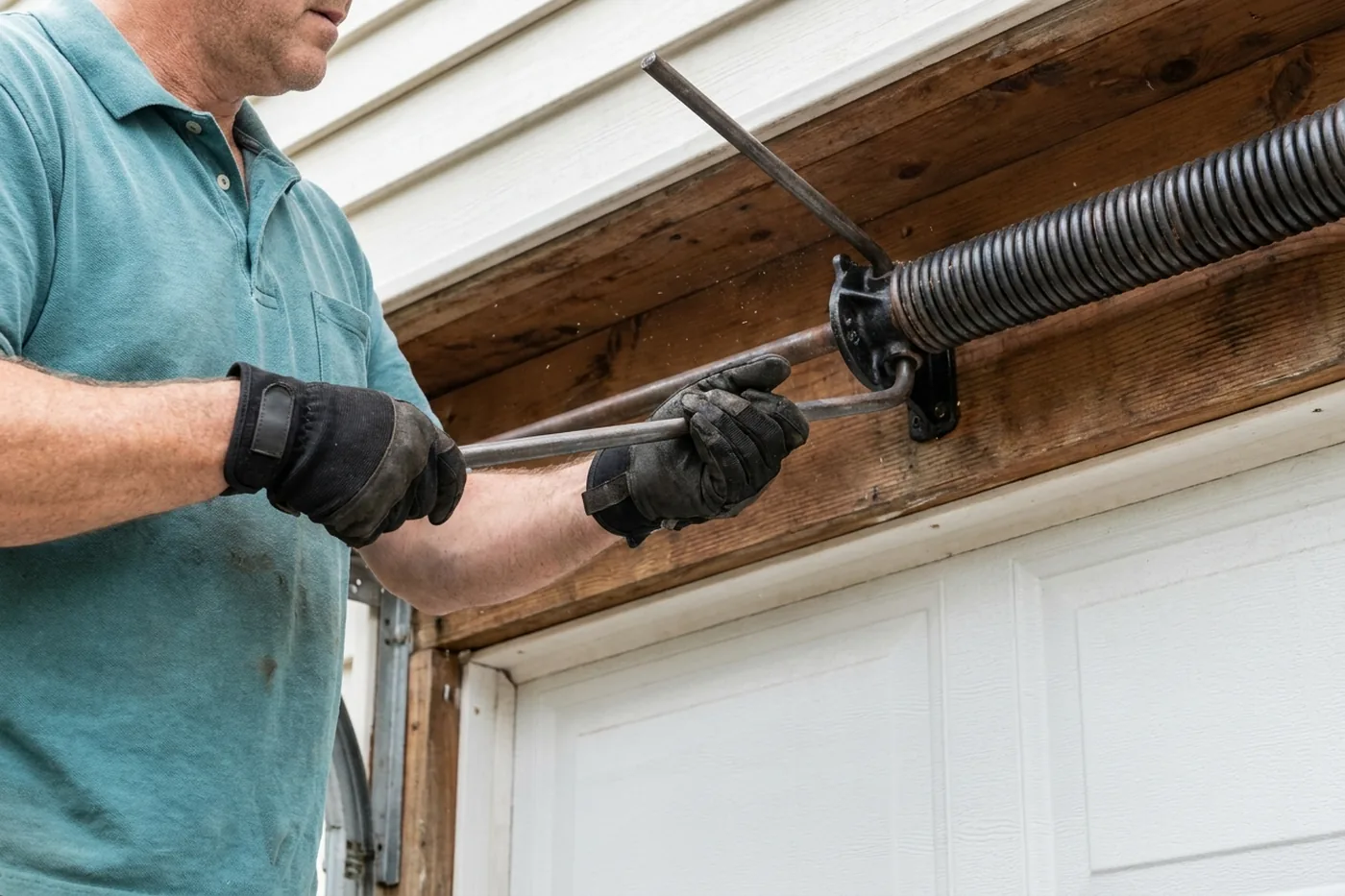
Homeowner lube on the coils is fine. Winding, unwinding, or "just tightening" a torsion spring is not. A loaded spring stores enough energy to lift 200 pounds ten thousand times, and it releases all of it in one bad quarter-turn. DASMA guidance is blunt: trained technicians, winding bars, correct fixtures. No exceptions.
Leave cables and drums alone
Lift cables are under the same load as the springs, and they whip sideways when released wrong. Even re-seating a cable that slipped off a drum requires the spring unwound and the door blocked. If a cable looks frayed, stop using the door and call us, that's a same-day slot.
Don't crank up the opener force
When a door gets heavy, people max out the opener's force setting to muscle through it. Now the opener is masking a spring problem, and worse, a maxed-force door may not reverse on a child, a pet, or a bumper. Force limits exist for the safety circuit. Fix the balance, not the setting.
When to book, by region.
Any tune-up beats no tune-up. But if you're picking a season, pick the one that gets ahead of your region's hard months.
How often should a garage door be serviced in Georgia?
What does a Mo Better garage door tune-up include?
How long does a garage door tune-up take?
Can I lubricate my garage door myself?
Will you try to sell me parts I don't need?
When is the best time of year for garage door maintenance in Georgia?
Does maintenance actually prevent spring failure?
One hour a year beats one Waaaay worse morning.
Book the tune-up. Lube, balance, cables, rollers, sensors, hardware, written findings, no invented problems, same techs as our repair crews.
"Mo Better Garage, we make it waaaay 'mo better."