Garage Door Seal Replacement, Shut Out Georgia Weather.
Daylight under the door? Puddle after every storm? Yellow pollen film on the car? Your seals are done. A Mo Better tech replaces the bottom seal, weatherstripping, and threshold in one visit, usually under an hour.
Storm coming and the garage floods every time? A threshold-plus-seal install before the rain beats a shop-vac after it. Bundle it with a tune-up →

Direct answer
Garage door seal replacement near you, across Metro Atlanta, Coastal Georgia & Northeast Florida.
Mo Better Garage replaces garage door bottom seals, side and top weatherstripping, and floor-mounted threshold seals the same day you call, from Atlanta to Brunswick, Savannah, and Jacksonville. The quick self-check: close the door, turn off the lights, and look for daylight along the bottom, light means the seal has quit, and rain, pollen, red-clay dust, and pests are already using the gap. We match the seal type to your retainer (bulb, T-type, or U-type), replace corroded retainers when the rubber won't save them, and add threshold ramps where cracked or sunken Georgia slabs leave low spots a door seal can't reach. Coastal homes get wind-driven-rain packages sized for tropical weather. Most bottom seals are done in under an hour. Call (770) 588-1037, written quote first, licensed and insured in Georgia, license #853.
"It's just a seal" is how garages quietly rot.
You want to know the call nobody in this industry wants? The seal call. Too small for the big outfits, they'll quote you a week out and hope you forget. So the homeowner grabs a universal strip from the big-box store, staples it on crooked, and six months later there's a water line on the drywall, a mouse condo in the corner, and rust starting up the bottom panel. All from a strip of rubber nobody respected.
And the kicker: that rotting bottom section? Now it's a real repair, ten times the cost of the seal that would've prevented it. I've walked into that garage a thousand times. The seal is the cheapest part on the whole door and it protects the most expensive habits of Georgia weather.
Mo Better trucks take seal calls happily, same-day, no minimum-job attitude. The tech measures your gap, matches the retainer, checks the slab for low spots, and seals the whole perimeter, bottom, sides, top, in one visit. Costs less than the water damage it prevents. Every time.
No job too small. No gap left open.

What's coming in under your door?
Every intruder, water, dust, bugs, drafts, exploits a specific gap. Find what's getting in, and you've found which seal quit.
A stripe of daylight under the door
The definitive test, failed. Close the door, lights off, look along the floor line. Light means the bottom seal is flattened, torn, or the slab has dipped below its reach. Everything else on this list follows through that same gap.
Bottom seal replacementWater pooling inside after every storm
Georgia downpours find the low spot. If the driveway slopes toward the house or the slab has a dip, rain sheets under the door faster than a plain seal can block it. The fix is a floor-mounted threshold ramp mated to a fresh bulb seal.
Threshold + bulb sealYellow pollen film on everything, every April
Metro Atlanta's spring signature. Pine pollen hangs in the air for weeks and drifts through any breathing gap in the door's perimeter, then the summer's red-clay dust keeps the layer topped up. Full-perimeter sealing stops the garage from inhaling.
Perimeter weatherstrippingPalmetto bugs, mice, and worse
A torn seal corner is a pet door for pests. Roaches need almost nothing; mice need a dime's width. Every Georgia fall they head for warm, dry garages. Fresh rubber with intact corners takes the welcome mat away.
Pest-exclusion sealingWind-driven rain on the coast
Tropical weather doesn't rain down, it rains sideways. From Savannah to the Jacksonville beaches, storm gusts push water past seals that handle ordinary rain fine. Coastal packages pair a heavier bulb with a threshold and tight side seals.
Coastal storm packageDrafts, humidity, and a bonus room that won't hold temp
The energy leak nobody audits. A gapped 16-foot door breathes humid air all summer and bleeds heat all winter, brutal on conditioned garages, gyms, workshops, and any bedroom sitting above. Sealing the perimeter is the cheapest fix on the whole envelope.
Energy sealingFour seals, four different jobs.
"Garage door seal" is really a family of parts, and shops love to blur them. Here's who does what, so you know what you're buying.
Bottom seal, the workhorse
The rubber bulb, T, or U profile clipped into an aluminum retainer on the door's lowest edge. First defense against water, dust, and pests, and first to die in Georgia heat, the rubber bakes stiff, cracks, and flattens. We match the profile to your existing retainer so it seats right.
Retainer, the seal's foundation
The aluminum channel the rubber slides through. Straight and clean, it makes every future seal swap a ten-minute job. Bent or salt-corroded, common on coastal doors, it chews up new rubber, so it gets replaced with the seal. We check it before quoting either way.
Side + top weatherstripping
The vinyl flaps sealing the gap between the door and the jamb on both sides and across the top. This is what stops wind-blown rain, drafts, and Atlanta's pollen drift around the door's perimeter, the part most "just a bottom seal" jobs skip.
Threshold, for floors that moved
A ramp sealed to the concrete itself, mating with the bottom seal from below. The answer when the slab has cracked, sunk, or was poured with a low spot, and the backbone of every coastal wind-driven-rain package we install.
Between-panel seals
Slim gaskets in the joints between door sections, standard on newer insulated doors. When they age out on older doors, horizontal drafts show up mid-door, worth checking while the truck's already there.
Nail-on conversions
Older wood doors often have rubber nailed straight to the slab edge, every replacement means prying nails out of aging wood. We convert these to a retainer system once, and the next decade of seal swaps gets easy and cheap.
The two-minute self-check
Run the daylight test before you call anyone.
Unlike springs and cables, seals give you a diagnosis you can run yourself, safely, in slippers. Step one: close the door fully on a bright day. Step two: kill the garage lights and let your eyes adjust. Step three: walk the door slowly and look for light, along the floor line, up both sides, across the top, and at the joints between panels. Step four: note where the light lives. A glow at one floor corner is usually a torn seal end or a slab low spot. An even stripe across the whole bottom means the rubber has flattened with age. Light up the sides means the jamb weatherstripping has curled or cracked.
While you're down there, pinch the bottom seal. Healthy rubber feels like a fresh garden hose, pliable, springs back. Dead rubber feels like the hose you left behind the shed in 2019: stiff, chalky, cracked at every fold. Georgia's temperature swings, 95-degree pavement in July, hard freezes in January, cycle that rubber until it gives up, which is why seals here are a maintenance item, not a lifetime part.
Tell us what you found and we'll tell you what it needs, over the phone, before the truck rolls. That's the deal: you bring the two-minute test, we bring the exact rubber. Call Mo Better, and we'll come over and make it right.
Sealed tight, usually within the hour.
Report the daylight.
Tell us where the light or water shows up. Corner, full stripe, or sides, each points at different rubber, and the truck stocks accordingly.
Gap survey.
The tech maps the whole perimeter, seal condition, retainer health, slab low spots with a straightedge, before quoting anything.
One written price.
Exactly which seals, which profile, threshold or not, retainer or not, itemized and signed before the old rubber comes off.
Out with the fossil.
Old seal out, retainer cleaned or replaced, new rubber seated corner to corner, weatherstripping trimmed tight to the jamb.
The hose test.
We re-run the daylight check and, for water complaints, put a hose on the door line to prove the fix before we leave.
Seal calls pair well with these.
A seal visit is the cheapest truck roll we make, smart homeowners stack it with the repairs the gap was hiding.
Panel repair
Water that beat the old seal usually left its mark on the bottom section. If there's rust or rot starting, catch it now.
Panel details
Annual tune-up
Seals are already on the tune-up checklist, bundle them and the whole door gets inspected for one truck roll.
Tune-up details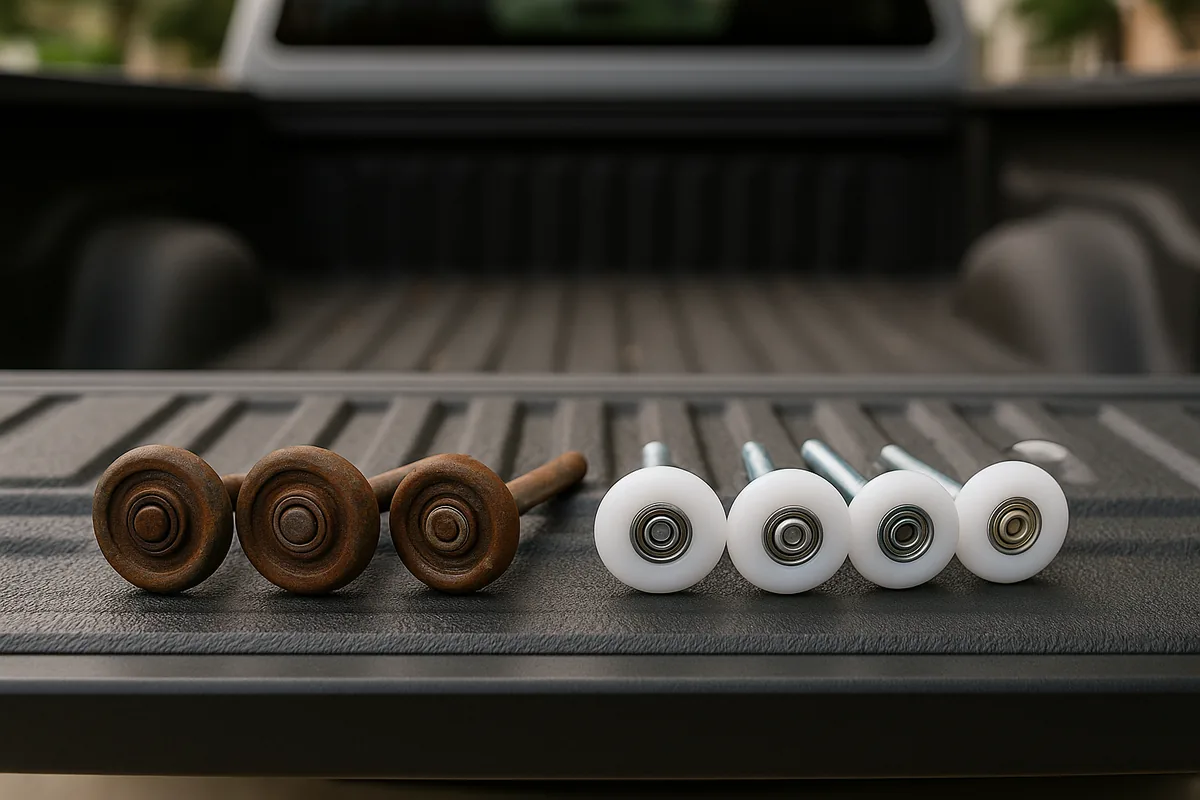
Roller replacement
The same pollen and clay dust that snuck past the seal has been grinding your roller bearings. Quiet both problems at once.
Roller details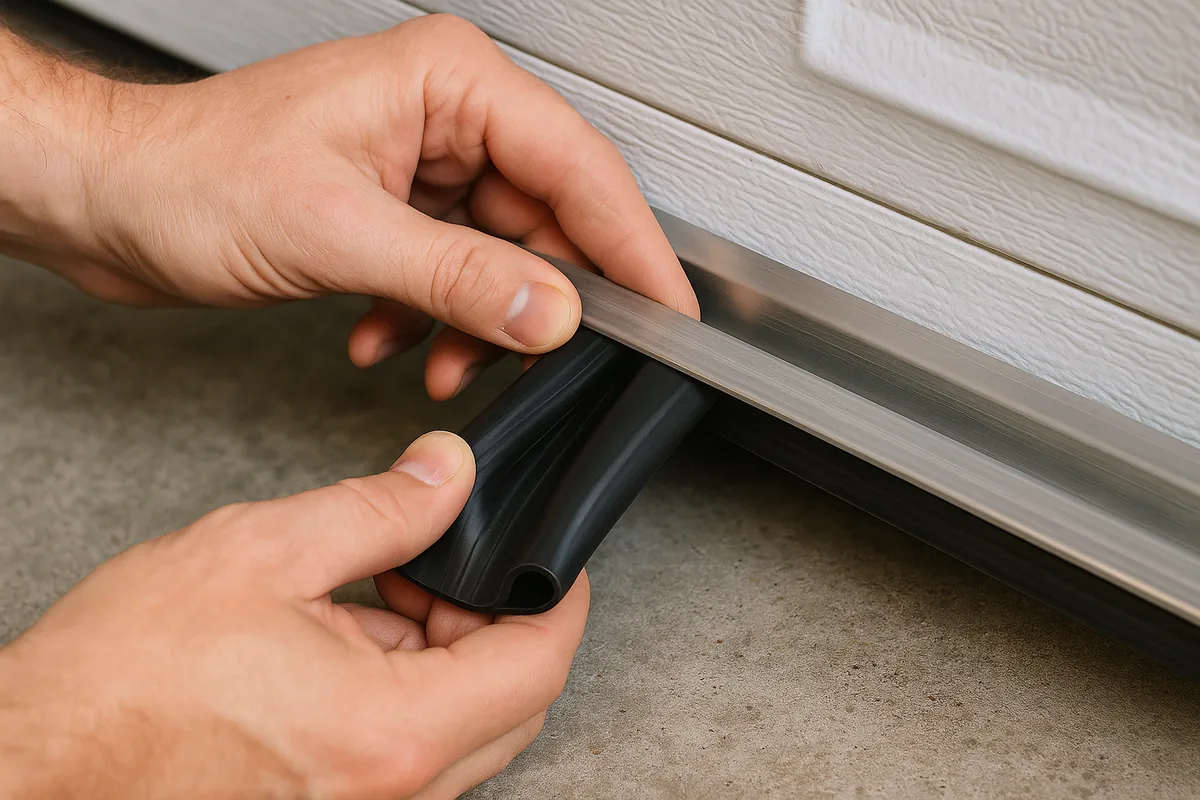
Insulated door upgrade
Conditioning the garage for good? A modern insulated door with factory perimeter seals beats retrofitting a thirty-year-old slab of steel.
Installation detailsSealed same-day, all three regions.
Brunswick shop
Brunswick seal details Coastal GA · Chatham · AnchorSavannah
Savannah seal details Metro ATL · Fulton · AnchorAtlanta
Atlanta seal details Metro ATL · Douglas · ShopDouglasville
Douglasville seal details Metro ATL · Cobb · ShopMarietta
Marietta seal details NE FL · Duval · AnchorJacksonville
Jacksonville seal detailsHow do I know if my garage door seal needs replacing?
Why is water getting under my garage door even after a new seal?
What's the difference between bottom seals, weatherstripping, and thresholds?
Will a new seal keep bugs, mice, and snakes out of my garage?
Does garage door sealing actually lower energy bills?
Why does yellow pollen and red dust keep coating everything in my garage?
Can you replace just the rubber, or does the whole retainer need to go?
How long does seal replacement take, and is it same-day?
Seeing daylight? Finding puddles? We make it Waaaay Mo Better.
Bottom seal, weatherstripping, threshold, the whole perimeter, sealed in one visit, usually under an hour.
"Mo Better Garage, we make it waaaay 'mo better."